Io

Io

Io is one of the closest and most prominent of Jupiter’s moons. Surprisingly, Io has the most volcanic activity of any of the worlds in our solar system. Usually, people think of moons as large barren rocks (similar to our own) however, Io breaks that mold. Because Io has such a large amount of volcanoes, we know that its internal temperature must be pretty high. This high internal temperature is due to tidal heating. Jupiter exerts a great tidal force on Io due its large mass. This large tidal force added to the fact that Io’s orbit around Jupiter is somewhat elliptical means that the size and orientation of Io’s tidal bulges are constantly changing. The changing in these tidal bulges causes Io to experience a lot of internal friction, which is what makes Io have a very hot interior. Not only is Io’s internal temperature what makes it interesting, the fact that it has a slightly elliptical orbit adds to its uniqueness. Typically, a moon or other large body of Io’s size would have a nearly circular orbit. However, due to the gravitational tug between Io and Jupiter’s other large moons, Io is moved into an elliptical orbit.
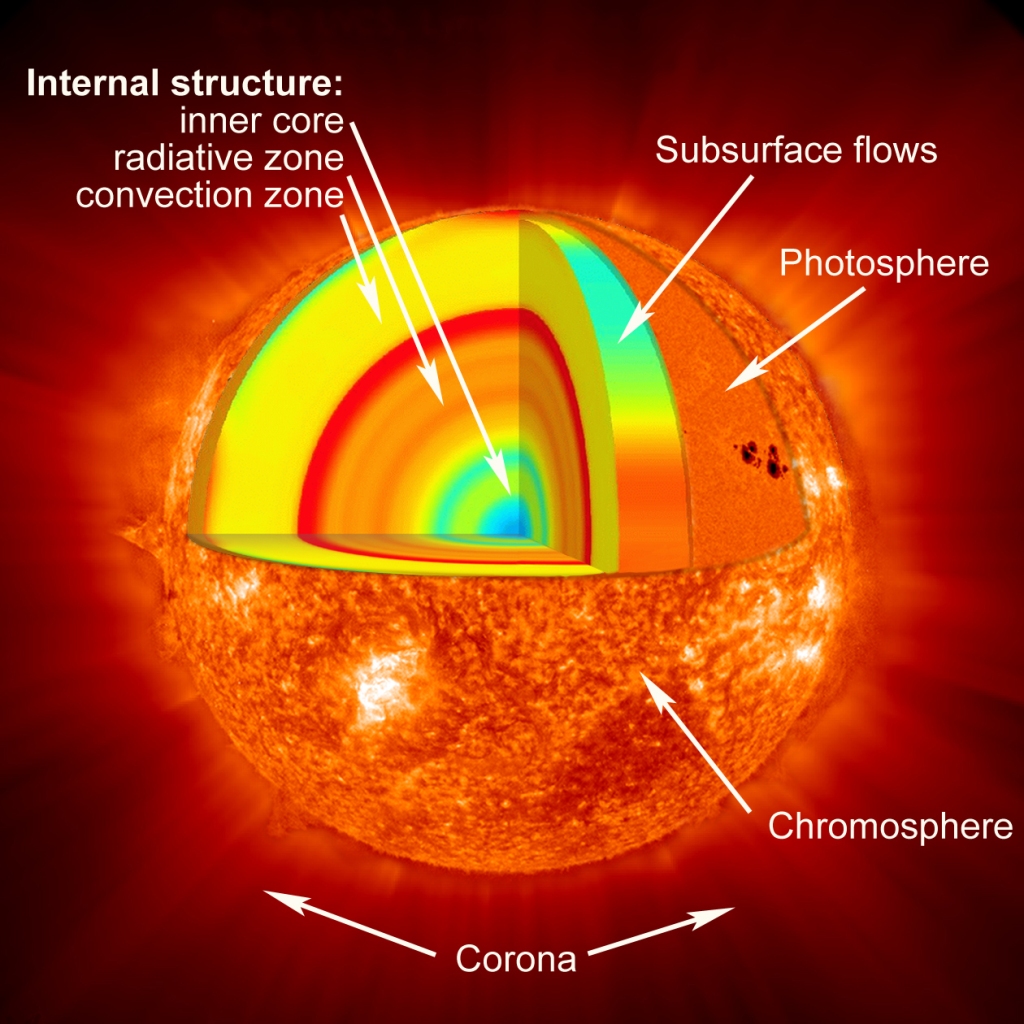
The Sun

The Suns Layers

Everyone knows the sun is what gives us light, much of our heat, and is vital to life on Earth, however there are many intriguing aspects that people do not know. The sun was formed four and a half billion years ago from the gas of a collapsing space cloud. This cloud continued to contract until the core was able to sustain nuclear fusion, which maintains energy balance between the energy being released into space from the suns surface and the core. The sun is roughly halfway through its ten-billion year lifetime, after which the suns “fuel” will run out and gravitational contraction will resume. The sun’s structure from inside out is the core, radiation zone, convection zone. Then, its atmosphere is made up of the photoshpere, chromoshpere, and the corona (the outer most layer of the sun’s atmosphere). In the sun’s core the temperature reaches around 15 million kelvin and the pressure is 200 billion times that on earth’s surface. In the next layer up, radiation zone, the temperature cools to around 10 million kelvin. Here, energy moves out in the form of photons. After this layer their is the convection zone, here the the cooler gas from the surface falls and the hotter gas rises. The sun is quite incredible in many ways and the extremes of the suns size, temperature, and gravity make it difficult to really comprehend.